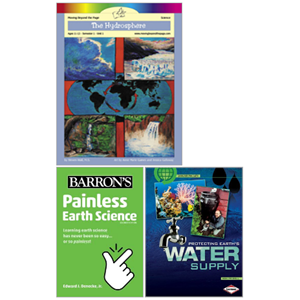







Water - The Story of the Hydrosphere
Water: The Story of the Hydrosphere by Lynne Z. Petkovic, M.Ed., J.D. introduces middle-grade students to the science of Earth’s water systems through clear writing and engaging visuals. The book explores how water cycles through the hydrosphere, how temperature and salinity influence density and ocean currents, and how these properties shape weather, climate, and ecosystems around the world.
This book is a key part of our homeschool science curriculum unit called The Hydrosphere. Concepts such as density, salinity, and water’s unique properties are explained with vivid illustrations and real-world examples. Challenging ideas are presented in a way that students can grasp—making this an ideal companion for guided or independent learning at home.
In our literature-based homeschool science curriculum, Water: The Story of the Hydrosphere is a central text used across multiple lessons. Students don’t just read the book—they explore, experiment, and engage with its ideas through meaningful activities. Here's how the book is integrated:
Anchoring Key Science Concepts
Students read chapters that explain how temperature and salinity affect the density of ocean water, leading to convection currents. These concepts are tied to written responses that ask students to reflect on how density drives motion in the oceans—and why that motion matters for life on Earth.
Supporting Hands-On Experiments
The book lays the foundation for several hands-on investigations, including:
- Mixing saltwater solutions and measuring their mass and volume
- Creating and testing colored ice cubes to model ocean layering
- Observing how density affects the movement of solutions in water
These experiments build a concrete understanding of physical science principles using simple materials—ideal for a home learning environment.
Strengthening Data Analysis and Scientific Thinking
Students gather data, record observations, and calculate density using the book’s concepts. They interpret graphs that connect pollution levels and dissolved oxygen in water and learn how environmental changes affect aquatic life. These activities foster the analytical thinking skills emphasized in our homeschool science curriculum.
Encouraging Inquiry and Real-World Connections
The unit culminates in an inquiry-based project. Students investigate a current issue affecting water systems—such as runoff, eutrophication, or salt levels in drinking water—and develop a scientific question to guide further exploration. This experience emphasizes the real-world relevance of water science and encourages students to see themselves as problem-solvers.
As part of our comprehensive homeschool science curriculum, Water: The Story of the Hydrosphere brings together reading, experimentation, data analysis, and inquiry. It helps students explore not just how water works—but why water matters.

Literature
This book is used in the following packages.